Content Warning: Childhood abandonment, family loss, difficult family transitions
Privacy Note: Names, locations, and identifying details have been changed to protect privacy. The emotional truth remains unchanged.
I have spent a lot of time thinking about what people really mean when they say that everything changed.
It sounds dramatic when you say it out loud, almost like a scene from a movie where the music swells, the sky darkens, and you can clearly see the exact moment a life splits into a before and an after.. But that was never how it happened for me.
The painful truth is that I had no idea I was living through my last normal day.
That is perhaps the hardest part of looking back. Nobody taps you on the shoulder to tell you to pay close attention because you will spend the next twenty-five years replaying that ordinary day in your head.
I was thirteen years old. I was too young to know that the world I recognized was about to disappear, not all at once, but slowly enough that I would not understand what I had lost until much later.
When I try to recall that day, the most striking thing about it is how ordinary it was.
My mother woke me up early so I could eat breakfast before taking a shower and getting ready for school. The house smelled familiar. I could smell the sharp, comforting scent of garlic from the fried rice she had cooked on the stove, mixed with the slightly burnt aroma of soy sauce from reheating leftover chicken adobo from the night before.
I sat down at the table, still half asleep. In front of me was my Tupperware lunch container, packed with freshly cooked white rice and a piece of fried chicken resting on top. Next to it was a crisp twenty-peso bill, my allowance for the day.
While I ate, my mother stood nearby with the iron, smoothing out the fabric of my school uniform. As she pressed the pleats, she reminded me to be careful during the day because she had just finished fixing the hem of my skirt.
It was a routine that had happened hundreds of times before. It had played out so many mornings in a row that when I look back on it now, I sometimes catch myself wondering if I am making the memory up.
The rhythm of that morning was so familiar that nothing about it suggested an ending.
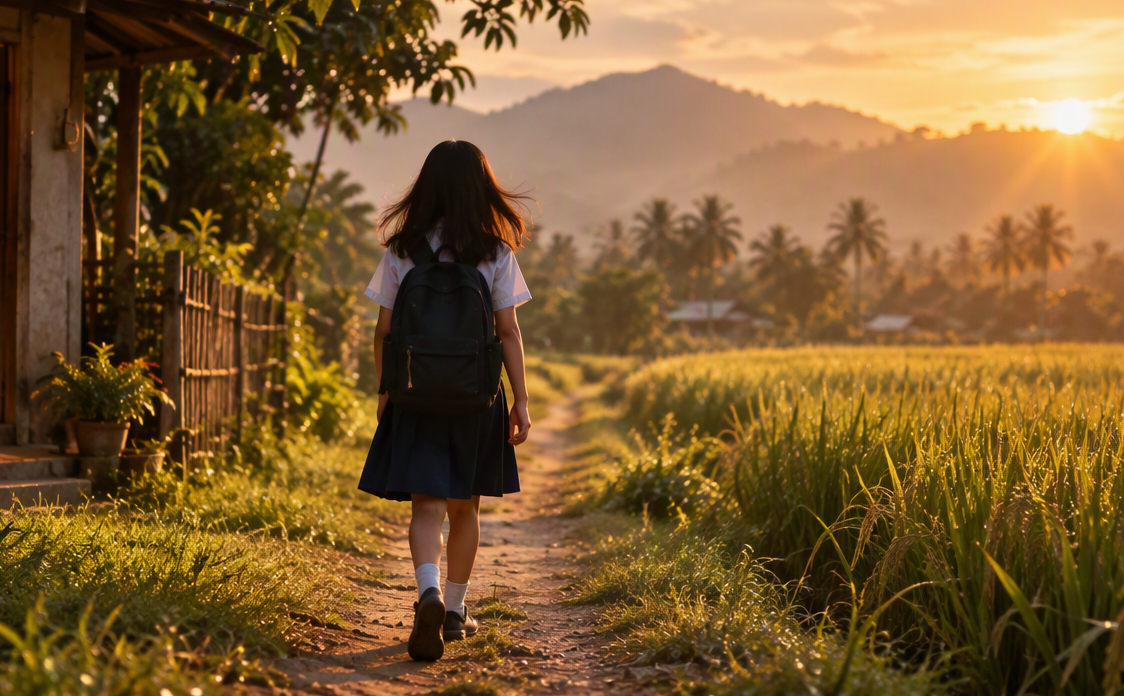
The walk to school is one of the things I remember most clearly. It was the very same dirt path I had walked every morning since I started going to school. On rainy days, it became muddy and slippery under my shoes. During the farming season, the palay would grow so tall that a small girl could disappear while walking through it. I still remember the sudden burst of fear, running as fast as I could the second I spotted a cow getting a little too close to the trail. And when harvest season arrived, walking down that path felt like stepping straight into a field of gold.
It was the same path I always walked on my way back home, knowing my mother would be waiting for me. I would walk through the door and immediately ask her if we had any leftover rice, as I was always hungry after a full day of school.
But that afternoon, it was simply the road taking me back to the only life I knew.
When I got home, my mother was receiving a phone call.
After the call, she told me,
“Your father called.”
That was the only thing that felt unusual about the day.
Childhood is built on the assumption that tomorrow will look a lot like today. The people sitting across from you at breakfast will still be there next week, next month, and next year. Looking back, I realize how safe I felt without ever having to think about what being safe meant. I simply believed the people I loved would still be there.
Children are supposed to believe their parents will stay.
At thirteen, I believed my father would finish his overseas contract and come home to us. I believed my mother would always be there to look after me. I believed family troubles were temporary problems that grown-ups would figure out. I believed that when people loved each other, they found a way to make things work.
I understand now how little control I had over what came next. The adults around me made choices I had no voice in, but I would spend years living with what those choices left behind.
Sometimes people ask if I would go back in time and warn my younger self if I had the chance. But every time I think about that thirteen-year-old girl sitting at the kitchen table, eating her garlic rice and listening to the sound of the iron, I know in my heart that I would not say a single word.
What would be the point of stealing her peace ahead of time?
If I could step back into that kitchen, I would simply let her have that one last normal day. I would let her eat her breakfast without fear. I would let her go to school without knowing what was waiting for her. I would give her that final afternoon of simply being a child, before leaving became something she learned to fear.
The questions that began around that time followed me into adulthood. They became quieter as I built a career, created a home, and tried to make a good life for myself.
But quiet is not the same as gone.
That is why I keep returning to that quiet morning.
It was the last day I was simply someone’s protected child. I just didn’t know it yet.
I cannot give that girl her old life back. But I can remember her as she was that morning: sleepy at the kitchen table, eating garlic rice while her mother ironed her school uniform, with no reason yet to believe that the people she loved could leave.
If you had the chance to go back and spend one ordinary day with your younger self right before everything in your life shifted, would you try to warn them, or would you simply let them have that last piece of peace?
If You Found This By Accident
Thank you for reading.
Sometimes people arrive here through a shared post, a search result, or a random late-night click. If that’s how you got here, and it feels like you’re missing part of the story, you probably are.
This post is just one piece of a much larger journey.
You can start with:
Wherever you begin, welcome!
Leave a Reply